
Bank of Baroda economists project India's GDP to grow 6.5-6.8 per cent in FY27 but warn that the fiscal deficit could overshoot the budgeted 4.3 per cent target, potentially reaching 4.7-4.8 per cent of GDP due to subsidy overruns, excise duty cuts, and oil marketing company losses.

As India marks a decade of the Goods and Services Tax (GST), the focus is shifting towards enhancing efficiency through artificial intelligence, data sharing, and process simplification. The reform, which unified India's indirect tax system, has significantly broadened the tax base and boosted revenues, with future plans including a streamlined two-tier rate structure and continued technological integration to reduce compliance costs and combat evasion.

Foreign Portfolio Investors (FPIs) withdrew nearly Rs 33,000 crore from Indian equities in May, bringing the total outflow for 2026 to Rs 2.25 lakh crore, driven by weak earnings growth, rupee depreciation, and more attractive opportunities in other global markets.

As Mumbai grapples with rising temperatures and humidity, many slum dwellers are spending their nights on Versova beach to escape the unbearable heat in their poorly ventilated homes, with the India Meteorological Department (IMD) forecasting a gradual rise in temperatures before a decline, and a yellow alert for isolated rainfall.

Indian benchmark equity indices Sensex and Nifty surged in early trade, driven by a sharp correction in crude oil prices below USD 100 per barrel and a rally in global markets, fuelled by improving sentiment surrounding US-Iran negotiations.
India Ratings and Research predicts the Reserve Bank of India (RBI) will maintain the repo rate at 5.25 per cent throughout FY27, despite potential inflationary pressures from higher fuel prices, with inflation expected to remain within the central bank's tolerance band.

India's services sector growth reached a five-month high in April, with the HSBC India Services PMI Business Activity Index rising to 58.8, primarily driven by robust domestic demand and a shift from international to local suppliers amidst the West Asia crisis.

Global oil prices fell on Thursday to their lowest levels since before the outbreak of the Iran conflict, offering a significant economic tailwind for India, the world's third-largest crude importer, by easing inflation risks, reducing the import bill and improving the government's fiscal position.

Apple CEO Tim Cook expresses strong optimism about the Indian market, citing its potential for growth and the company's recent successes in the region.

Info Edge (India), the company behind Naukri.com, has seen its startup investment portfolio, spanning AI, deeptech, and consumer tech, grow to Rs 41,300 crore from an investment of Rs 4,900 crore since 2007. This significant valuation increase comes despite headwinds in its core recruitment business, which has been impacted by weak hiring trends and IT sector uncertainty.
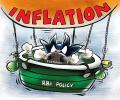
The Reserve Bank of India has increased its retail inflation projection for 2026-27 to 5.1 per cent, up from an earlier estimate of 4.6 per cent. This revision is primarily attributed to mounting input costs, driven by the pass-through of higher global energy prices to domestic petrol and diesel rates, which have seen significant increases since May.

Mahindra & Mahindra (M&M) is expanding its farm equipment strategy beyond tractors to include a wider range of mechanisation solutions like harvesters, balers, seed drills, and telematics-enabled services, aiming to capitalise on the growing demand for rental services by rural entrepreneurs and address low mechanisation levels in Indian agriculture.

Despite the Reserve Bank of India's (RBI) and the government's recent initiatives to attract foreign capital, which are expected to alleviate pressure on long-duration bonds, most debt fund managers are maintaining a cautious stance, favouring shorter-duration papers due to global uncertainties and potential future rate hikes.

India is closely monitoring Sri Lanka's decision to offer foreign investors control of an airport near the China-controlled Hambantota port, as it could present a rare opening for Indian firms seeking strategic footholds in the Indian Ocean.

Global brokerage Citi has reduced its Nifty 50 index target to 26,000 from 27,000, citing persistent geopolitical tensions, risks to corporate earnings growth, and concerns about India's role in the global artificial intelligence (AI) ecosystem.

Shares of power generation-related companies surged on Wednesday, with the BSE Power index hitting a new high of 8,497, driven by strong demand, robust order books, and significant capital expenditure announcements from key players like Hitachi Energy India, Adani Green Energy, and CG Power and Industrial Solutions.

The demerger of Vedanta's four new entities - Vedanta Aluminium Metal, Vedanta Oil & Gas, Vedanta Power, and Vedanta Iron & Steel - has led to a 16% appreciation in aggregated market capitalisation, with Vedanta Aluminium Metal identified as a likely near-term top performer due to its scale, low production costs, and favourable commodities cycle.

A potential US-Iran peace deal, expected to be signed on June 19, is anticipated to ease geopolitical stress and benefit various sectors, particularly in India, with analysts suggesting investors await finer details before making significant moves.

Hyundai Motor India Ltd reported a 22.22 per cent decline in consolidated profit after tax to Rs 1,255.63 crore in the March quarter, primarily due to higher expenses, despite an increase in total revenue from operations.

India's electric vehicle market is experiencing an unprecedented boom with a 37 per cent increase in new entrants, driven by supportive policies and infrastructure.

India's exports recorded a 13.78 per cent increase to USD 43.56 billion in April, marking the highest monthly outbound shipments in over four years, primarily driven by petroleum products. However, the trade deficit widened to a three-month high of USD 28.38 billion due to a 10 per cent rise in imports.

Indian benchmark indices Sensex and Nifty climbed in early trade, driven by buying in blue-chip stocks like Reliance Industries and ICICI Bank, alongside a notable cooling in crude oil prices.

Indian companies recorded their highest profit margins in 21 quarters during Q4FY26, reaching 11.3 per cent, primarily due to significant savings from lower employee costs and reduced interest payments, which offset rising raw material prices.

Net mutual fund inflows into active equity schemes in India plummeted by 40 per cent month-on-month in May, reaching a one-year low of 22,908 crore, primarily due to weaker lump-sum investments and increased redemptions amidst significant market volatility and global uncertainties.

Indian defence stocks have seen an average year-on-year gain of 67 per cent, driven by renewed interest following 'Operation Sindoor' and a broader increase in global geopolitical tensions, with the combined market capitalisation of 18 firms increasing by approximately 2.3 trillion.

The case for long-term investment in gold, however, remains intact.

Indian benchmark equity indices, Sensex and Nifty, ended lower after a five-day rally, with the Sensex dropping 607 points and the Nifty falling to 24,013.10. The decline was primarily driven by heavy selling in IT firms following Accenture's trimmed revenue guidance and renewed geopolitical uncertainty, specifically the postponement of US-Iran negotiations.

The Union Housing and Urban Affairs Minister's announcement of four 'Namo Cities' aims to decentralise development and decongest Delhi, but experts warn that the initiative may face execution challenges similar to previous urbanisation plans due to inadequate coordination among NCR states.

Despite reporting a weaker-than-expected net loss of Rs 2,536 crore for Q4FY26, largely due to a significant non-cash forex loss, analysts remain optimistic about IndiGo's long-term prospects, citing strong demand trends, a favourable pricing outlook, and strategic cost-control measures.

Analysts are revising down India Inc's financial year 2026-27 (FY27) earnings growth forecasts, citing persistently high crude oil prices above $100 a barrel due to the West Asia conflict, which is expected to dent corporate financial performance in the coming quarters.

The luxury carmaker plans to drive growth through local assembly of the MINI Countryman, expansion into 10 new cities and a broader product portfolio.

Escalating geopolitical tensions in West Asia are beginning to disrupt India's automotive supply chain, leading to rising commodity prices, logistics bottlenecks, material shortages, and pressure on consumer demand, with two-wheeler makers already raising prices.

Indian selection committee has advised Test and ODI captain Shubman Gill to prioritise red-ball and 50-over cricket until the 2027 ODI World Cup to manage his workload and ensure freshness for major ICC assignments, despite his strong IPL performance.

The Reserve Bank of India (RBI) has kept its key lending rate, the repo rate, unchanged at 5.25 per cent for the second consecutive time, citing concerns over rising energy prices, supply disruptions from the West Asia crisis, and potential inflationary pressures.

The gems and jewellery industry anticipates challenging times following the government's decision to increase gold import duty to 15 per cent, a move that exporters warn could fuel the grey market and heighten smuggling risks.
Indian IT stocks experienced a significant downturn following OpenAI's acquisition of consulting firm Tomoro, intensifying fears that global AI companies are encroaching on traditional IT service models through end-to-end consulting and implementation services.

Moody's Ratings on Monday downgraded Tata Motors' outlook to negative from positive following a cyber attack on its British arm Jaguar Land Rover which has led to a complete production halt. The rating agency affirmed the Mumbai-based auto major's Ba1 corporate family rating (CFR).

Champagne consumption in India is expanding beyond major metropolitan areas into smaller cities like Kanpur, Guwahati, and Lucknow, driven by a desire for sophisticated lifestyle declarations and a growing appreciation for the beverage.

The Indian equity market is set for an event-heavy week, with analysts pointing to the Reserve Bank of India's (RBI) interest rate decision, developments in the US-Iran situation, and crude oil prices as the primary determinants of market trends.

Foreign Portfolio Investors (FPIs) have withdrawn nearly Rs 43,000 crore from Indian equities in the first week of June, contributing to a total outflow of Rs 2.67 lakh crore in 2026, driven by a global shift towards technology and AI-linked opportunities and persistent rupee depreciation.
